
Studying French at A Level is not just about learning more vocabulary and refining your grammar. By studying topics such as crime and the law, current affairs in France, politics, diversity, immigration, French cinema and the French music scene, you will learn much more about France and the French. You will start to understand their attitudes, their passions and their fears.
COURSE CONTENT AND AIMS
In 2015, the terrorist attack on the Charlie Hebdo offices in Paris, triggered after journalists of the satirical newspaper had published disrespectful images of the prophet Mohammed, sparked a huge debate in France about the freedom of speech. Should the newspaper have been allowed to publish such images? How can we protect journalists from becoming targets for terrorists? How did this incident trigger the subsequent wave of terrorist attacks in France?
In 2019, the fire which caused huge damage to Notre Dame cathedral raised several questions across the world. Who would pay for the renovations of this building of national and international importance? Should it be rebuilt as it was, or should it be modernised with a roof-top garden and modern glass spire?
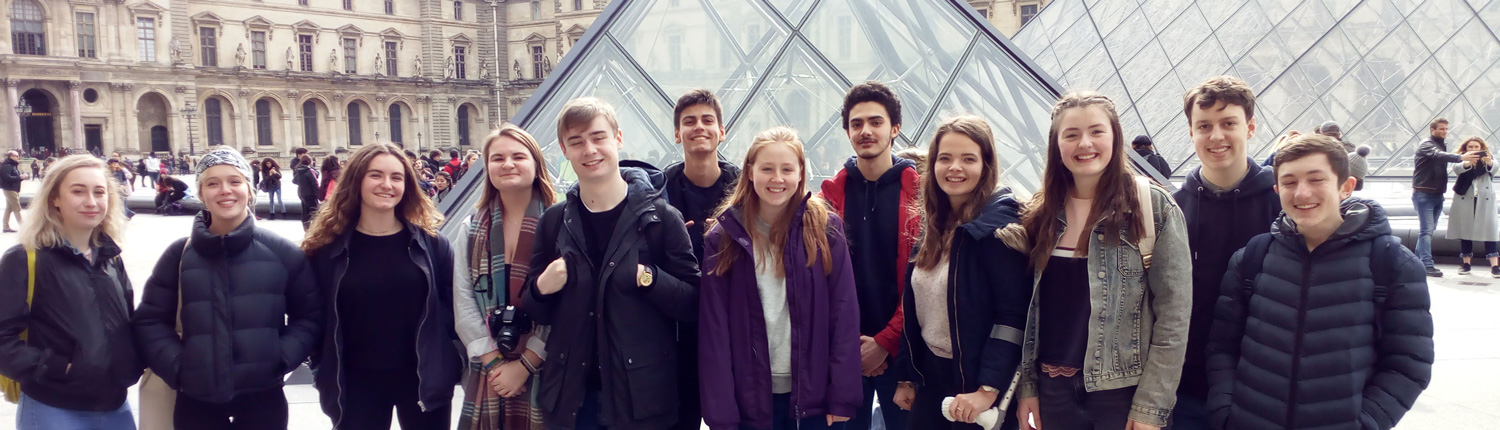
French is a practical subject with transferable skills. The course aims to equip you so that you may understand and converse with native speakers and live alongside them. You will continue to develop listening, speaking, reading, writing and translations skills and with determination, enthusiasm and patience you will become a confident linguist. During the course you will have the chance to practise your skills during a study visit to Paris. There you will visit a Parisian school and be paired with a French partner who will accompany us on joint trips around the capital.
French can be combined with any other subject and will positively enhance many. Studying French will particularly complement English, as you will spot patterns in language and discover French literature; it also complements humanities subjects, as we study a film set in occupied France, a novel packed with philosophical questions, and traditions in different francophone countries.
Learning French at A level provides a gateway that will help you to understand other cultures – not just French – and give you the techniques, and inspiration, needed to learn other languages.
Whether you continue with French at university, or not, having studied a language is a huge and impressive advantage. It is one subject that you will never need to justify choosing.
TRIPS AND VISITS
There will be the opportunity to take part in an immersion trip to France through the medium of work experience.
PROGRESSION
French A level is highly regarded by universities and can lead to a wide variety of Degree courses and career opportunities. French can be combined with a variety of subjects such as History, Law, Business Studies and Marketing. Studying French at A Level can also be combined with another language, such as Russian and Italian. Traditional careers such as teaching, translating and interpreting and civil service are often pursued, but language graduates are highly valued and sought after by employers in the business and commercial world enhancing your skills of essay writing and extended reports.
ASSESSMENT
The course is linear and assessment is by three terminal examinations.
Paper 1: (2 1/2 hours)
Listening, reading, writing.
Grammar – translation
Paper 2: (2 hours)
Written responses in French to questions on the film and the text.
Paper 3: (21-23 minutes)
Speaking. Discussion of a sub-theme and individual research project.
ENTRY REQUIREMENTS
For admission to A level French, our usual minimum requirements are:
- Students will need to have achieved a grade 6 or above in French.